Dry Sauna vs Wet Sauna: Understanding the Difference
If you have searched for "dry sauna vs. wet sauna," you've probably noticed how casually the terms "sauna" and "steam room" are used, as if they mean the same thing. In the United States, especially, this has created real confusion around what a sauna actually is, how it works, and why different heat environments feel so distinct to the body.
This article exists to slow that conversation down. You'll be able to choose the heat that best suits you, understanding the why and how behind each option.
While water on hot stones can create steam, a real sauna is not a steam room. The two environments are built and heated differently, and they are experienced differently physically, mentally, and culturally.
What follows is not a sales pitch or a surface-level comparison. It is a grounded explanation of dry saunas vs. wet saunas, written from a place of respect for traditional sauna culture and for the people trying to make informed choices.
Sauna from Finland recommends showering before entering the sauna; we agree. Good thing you can get these Finnish products shipped from Los Angeles.
By the end, you will understand not just the technical differences but why one experience feels alive and dynamic while the other feels fixed and enclosed, and which one actually belongs in your life.
First, Let's be Clear about Language
In traditional Finnish culture, the term "sauna" refers to a specific practice. It is a heated room with stones designed for high temperatures and adjustable humidity, where bathers actively shape the heat through water timing and rest.
In contrast, what Americans usually call a wet sauna is almost always a steam room.
That distinction matters.
A steam room is a fully humid space where steam is mechanically generated and pumped into the room. A sauna is a stone-heated room where humidity rises and falls based on how water is introduced to the stones. The experiences may overlap at a distance, but they are not the same.
Calling a steam room a sauna flattens that distinction and erases what makes a sauna a sauna.
What People Mean by Wet Sauna in the United States
When someone in the US says wet sauna they are almost always referring to a steam room.
Steam rooms operate by boiling water in a steam generator and releasing that vapor into an enclosed space. The air quickly becomes saturated. Humidity rises to near 100 percent and stays there. Condensation forms on every surface. The room is sealed to retain moisture.
The temperature, however, is relatively low, typically somewhere between 90 and 120 degrees Fahrenheit. The warmth is felt less as radiant heat and more as an enveloping dampness.
This environment is intentionally constant. Once the steam is on, the room stays wet. There is no adjustment, no rhythm, no variation unless you compare when the steam is coming out, and when it has shut off… often starting to feel cooler in the room.
The Steam Room Experience
Reflect for a moment: When did humidity last feel calming to you, or when did it become suffocating? For some people, a steam room feels soothing. The warm, moist air can temporarily relieve congestion. Dry skin may feel softer afterward. Muscles loosen gently after light movement.
For others, the experience is less pleasant. The air can feel heavy. Breathing deeply may feel difficult. Sweat forms, but it does not evaporate. Time often feels slower, not because of calm but because of discomfort.
Neither response is wrong. It is simply a different kind of heat.
Steam rooms are passive experiences. You enter, you sit, you leave. The environment does not respond to you. Five minutes in, your watch seems frozen; each second stretches into an interminable moment that highlights the space's stillness.
Steam Rooms Have Benefits and Limits
There is nothing inherently wrong with steam rooms. They can be useful tools, particularly for short sessions focused on relaxation or respiratory comfort.
But constant moisture comes with tradeoffs. Steam rooms require aggressive cleaning and ventilation. In shared spaces, hygiene becomes critical. And because humidity never drops, the body has fewer ways to regulate heat.
A steam room can feel gentle at first, until it doesn't.
What People Call a Dry Sauna and What It Actually Is
The term "dry sauna" is common, but it is not entirely accurate.
A traditional sauna is not meant to stay dry. It begins dry, yes, but only so that it can change.
What most people call a dry sauna is actually a traditional sauna with heated stones, where the air is dry until water is added. That moment when water meets stone marks the true beginning of the sauna.
As they say, "from the horse's mouth," there's probably no better person to deliver this information than the founder of the award-winning Löyly in Helsinki, Jasper Pääkkönen, as he clears up the biggest misconceptions about Finnish sauna culture.
How a Traditional (Finnish) Sauna Works
A traditional (Finnish) sauna is built around heat stored in stone.
A heater warms a large mass of stones, causing them to radiate heat evenly throughout the room. The air temperature often rises between 160 and 195 degrees Fahrenheit, but the humidity remains low until water is introduced.
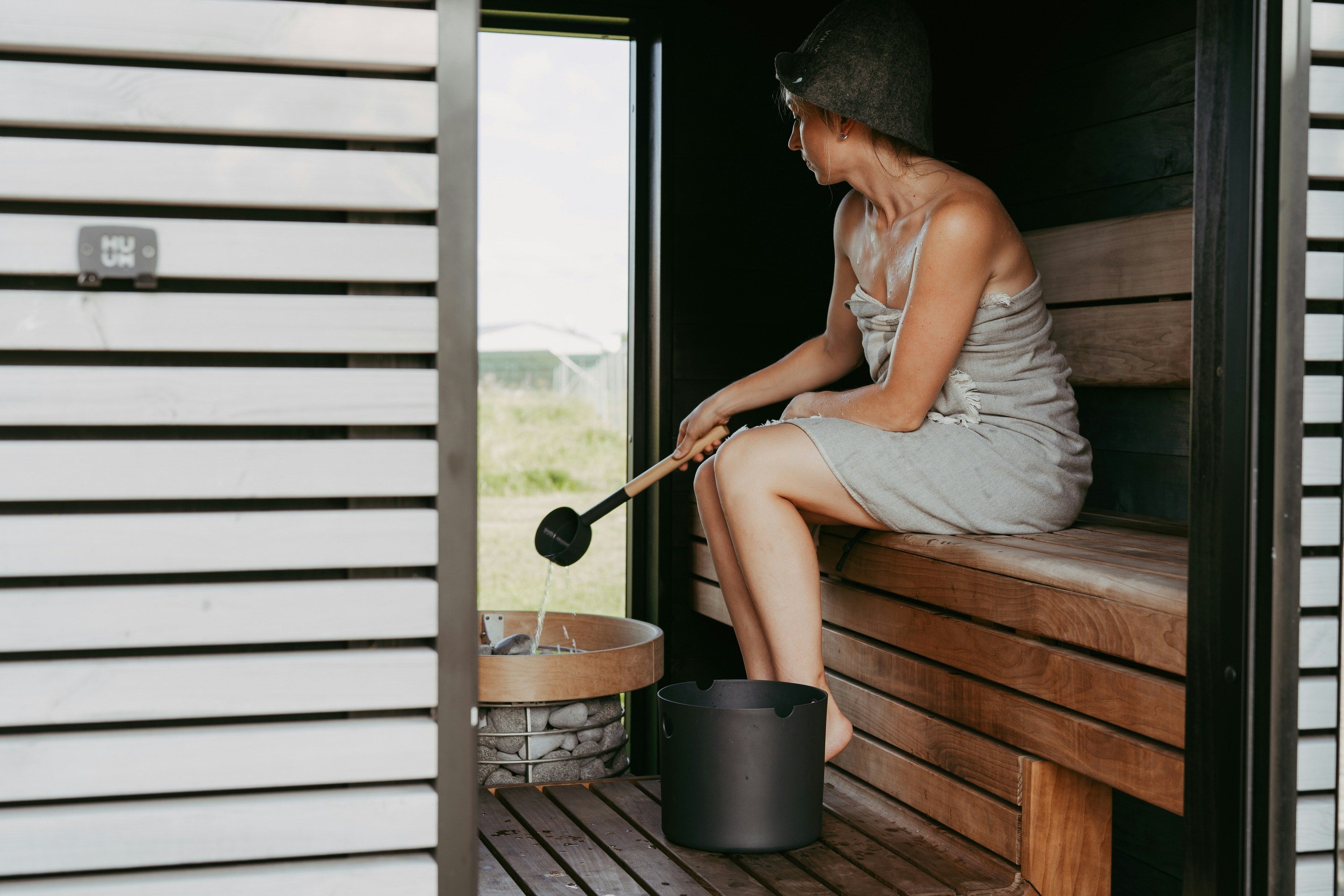
When water is poured onto the stones, it produces what the Finns call löyly. If you want to kick up your sauna and löyly experience, try any of our aromas, specifically formulated for adding to your water bucket. You can view all twelve here.
Löyly does not linger like steam in a steam room. It moves through the space, softens the heat, then dissipates. The room breathes. The heat changes. The body responds.
This cycle can be repeated as often or as gently as the bathers choose.
Löyly Is Not Optional
Löyly is often translated as 'steam,' but that misses its meaning.
Löyly is the character of the heat. It is how the warmth wraps around you rather than pressing down on you. It is what allows high temperatures to feel tolerable, even comforting.
Without löyly, a sauna is just a hot room. With it, the sauna becomes dynamic.
This is why in Finnish sauna culture, a sauna without water on the stones is considered incomplete. The heat is meant to live, not stagnate.
Fun fact: the name and branding for Löy came from the word Löyly.
The Traditional Sauna Experience
A real sauna unfolds in rounds.
You sit. You sweat. You add water. The heat swells, then settles. You leave to cool off. You rest. You return.
It’s important to note that you don’t have to time your sessions or look to max out. I would encourage you to listen to your body and enter/exit as you feel is best for you.
This rhythm is essential. It is what makes sauna restorative rather than punishing. The contrast between heat and cool resets the nervous system. Time stretches. Conversation softens. Silence becomes comfortable.
Unlike a steam room, the sauna responds to you. You are not a passive occupant; you are a participant.
Health Benefits of Traditional Sauna Use
Traditional sauna bathing has been studied extensively, particularly in Finland, where sauna is practiced regularly across generations.
Regular sauna use has been associated with improved cardiovascular function, better circulation, reduced stress, improved sleep quality, and faster muscle recovery. These benefits are thought to come not from heat alone but from the combination of heat, humidity variation, and repeated cooling.
If you want to dive a bit deeper into the benefits, you can read Sauna and Heat Exposure by Dr. Andrew Huberman.
The sauna trains the body to adapt, not just endure.
Dry Sauna vs Wet Sauna: What Actually Differs
The most obvious difference is temperature. Traditional saunas are much hotter. Steam rooms are much wetter.
But the bigger difference is how the heat behaves.
In a sauna, heat radiates from stone and wood. Humidity rises and falls. Sweat evaporates. Breathing adjusts. The body finds rhythm.
In a steam room, heat is carried by moisture. The air is fixed. Sweat accumulates. Evaporation is limited. The experience is static.
One environment adapts to you. The other asks you to adapt to it.
So Which Is Better
That depends on what you are looking for.
If you want a gentler moisture-heavy environment for short sessions, a steam room may suit you. If you want a deeper, more flexible practice, something you can return to again and again, a traditional sauna offers far more range.
Many people enjoy both. But they are not interchangeable. A steam room is a tool. A sauna is a practice.
A Word on Safety
Regardless of the environment, heat deserves respect.
Hydrate before and after. Keep sessions reasonable. Cool down slowly. Pay attention to your body. When it comes to alcohol, I would say avoid before and after; however, depending on the country or culture, that might differ.
Sauna should leave you clearer, calmer, and more grounded, not depleted.
Infrared Saunas Are Something Else Entirely
Infrared saunas often enter this conversation, but they function differently. They heat the body directly using radiant panels without stones, steam, or löyly.
Some people find them useful. Others miss the ritual and depth of the traditional sauna.
They are not better or worse; they are just different. If you are in the market for an infrared sauna, check out https://heavenlyheatsaunas.com/
Choosing the Right Sauna for Your Life
If you are considering a sauna for your home, think beyond square footage and heater size.
Think about how often you will use it. Whether you want silence or conversation. Whether you want something that challenges you or something that simply warms you.
A well-designed sauna supports the body, but it also supports a way of being.
Final Thoughts
If you are still unsure about the difference, go try them all.
Traditional Finnish Sauna
Find a friend with a traditional (Finnish) sauna who knows how to pour some water on the rocks. Better yet, go to Finland. This is one of the best places in the world to visit and experience the sauna Löyly Helsinki. And if you go, you need to get the salmon soup. Extra points if you find out what fish it’s made with.
Dry Sauna
Go to a hotel or a gym, you will likely find a traditional sauna that says “no water on the stove.” You can see what it’s like to sit in a “dry” sauna and bake (sorry for that last part, I know it was a bit sassy.)
Infrared Sauna
Find someone who has an infrared sauna. It’s important to note that there is a wide range of infrared saunas, and some get hotter than others. Therefore, evidence suggests you may need to sit in an infrared sauna for up to 45 min to start seeing health benefits.
Steam Room
And last, call up your aunt or uncle and ask to go to their country club and sit in the steam room. Many larger Korean spas will have them. If you are in Chicago, Dallas, or Virginia, look for a King Spa.
Read more

If you have ever added essential oils to your sauna water, you are not alone. It is a common assumption. Oils smell good, they are available everywhere, the sauna is hot, so they must go together. ...
What to Wear to the Sauna: A Practical Cultural GuideIf you’ve ever searched for what to wear in the sauna, you’ve probably found wildly conflicting advice. That’s because sauna attire isn’t about ...